

In Nigeria, the three land title documents you will hear about most are the Certificate of Occupancy (C of O), the Right of Occupancy (R of O), and Governor's Consent. A C of O is the government's grant of ownership for up to 99 years. An R of O is the right or allocation that usually comes first. Governor's Consent is the approval you need when buying land that already carries a title. This guide explains what each one means, when you need it, and how to verify it before you pay.
Most property disputes in Nigeria are not really about location or price. They are about documents. Get the title right and the rest is negotiation. Get it wrong and no price is low enough. So it is worth understanding what these papers actually are.

The one law behind every Nigerian land title
Everything starts with the Land Use Act of 1978. Read the short version and it explains almost every document you will meet.
The Act vested all land in each state in the governor, to be held in trust for the people. You can read a plain summary of the Land Use Act if you want the detail. The practical effect is simple. You do not own land in Nigeria the way you might imagine. You hold a right to occupy and use it, granted by the state, for a set term. In the Federal Capital Territory, that role sits with the Minister of the FCT rather than a state governor, and the land is administered through the Federal Capital Development Authority.
Once you understand that the government is the ultimate grantor, the documents make sense. Each one is a different stage of that grant.
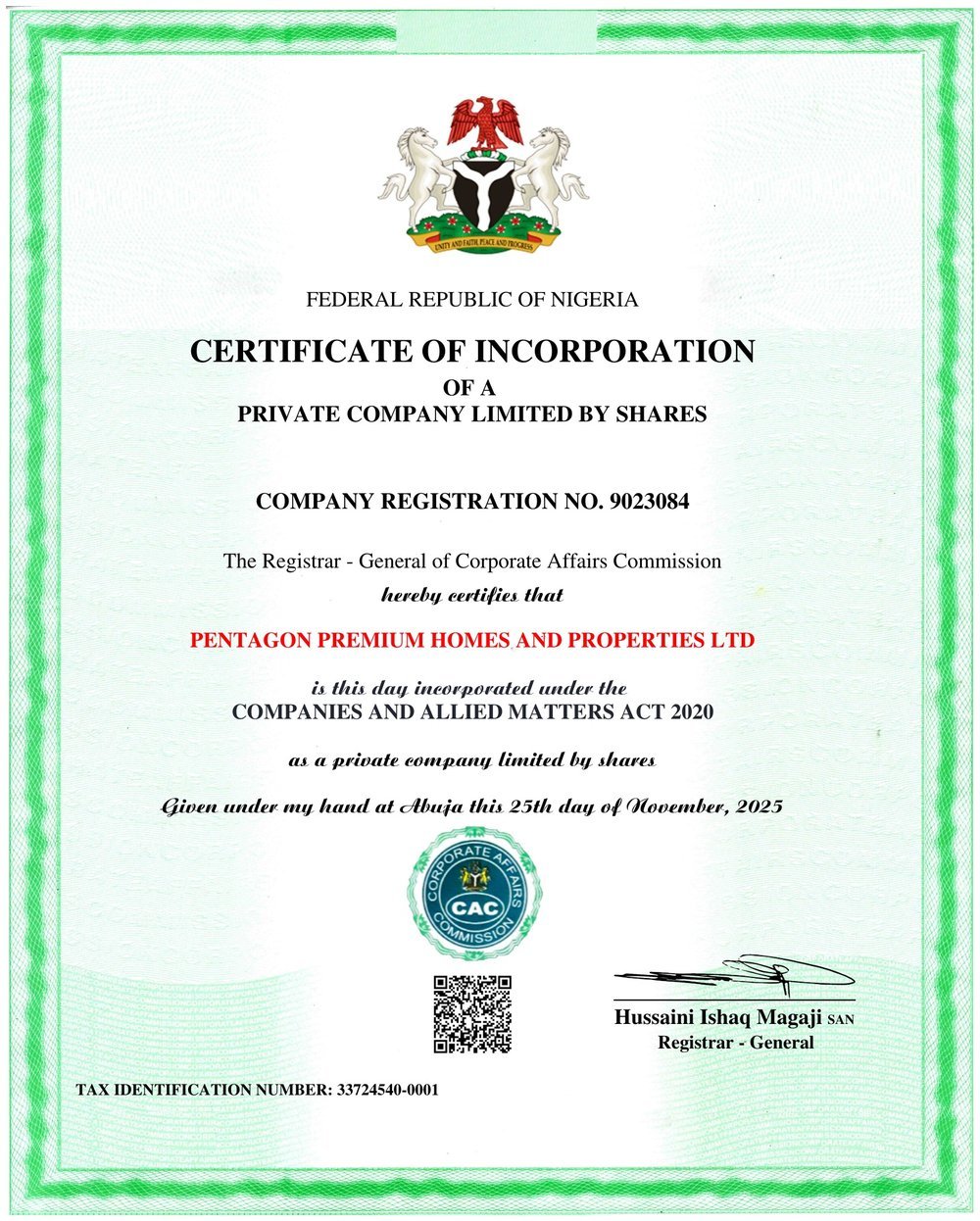
Certificate of Occupancy (C of O)
The Certificate of Occupancy is the strongest, most recognised title in Nigeria. It is the government's formal grant of ownership, for a term of up to 99 years.
A C of O is issued on a first allocation of land. In Abuja, an FCDA Certificate of Occupancy means the FCT authorities have granted and registered that title. It gives the holder the clearest claim to the land, the strongest hand in any dispute, and the right to compensation if the government ever acquires the plot. Every estate we sell is FCDA approved and titled, which is why we lead with it.
A genuine C of O carries specific details: the allottee's name, the plot and its location, the term of years, the permitted use, and the conditions attached to the grant. Those details are what a registry search checks against. If the name, plot number, or survey on the document does not match what the registry holds, that is a problem worth stopping for, no matter how official the paper looks.
That said, a C of O in the seller's name does not automatically become yours when you buy. This is where the next documents come in.

Right of Occupancy (R of O)
A Right of Occupancy is the right to occupy and use land, granted by the government. It often shows up as the allocation or offer of a statutory right of occupancy, the document that comes before the certificate.
Think of it this way. The R of O is the right itself. The C of O is the certificate that formally proves that right. A statutory right of occupancy is granted by the state in urban areas. A customary right of occupancy is granted by a local government in some cases. An R of O is real and valuable, but it is a stage in the process. You should confirm it is genuine and current, and understand the path from allocation to a full certificate before you rely on it.

Governor's Consent, and the FCT difference
Governor's Consent is the official approval for any transaction on land that already carries a title. It is not a first grant. It is permission to transfer.
Here is why it matters. Under the Land Use Act, when land that already has a C of O is sold, the buyer needs the governor's consent for that transfer to be valid. A C of O can only be issued once, to the first allottee. Every sale after that is perfected through consent, not a new certificate. Unlike a C of O, Governor's Consent has no fixed expiry and can be granted more than once as a property changes hands over the years.
In the Federal Capital Territory, there is no governor. The equivalent approval is the consent of the Minister of the FCT, processed through the FCT land administration and FCDA. The principle is identical. A resale of titled land is not complete in law until that consent is obtained.

C of O vs Governor's Consent: which one do you need
This is the question buyers ask us most, so here is the direct answer.
If the land is being allocated by the government for the first time, the title you want is a Certificate of Occupancy. If the land already has a C of O and you are buying it from a current owner, the document you personally need is Governor's Consent to the assignment, alongside a deed of assignment transferring the interest to you.
Put simply. First allocation, C of O. Resale of titled land, Governor's Consent. Both are legitimate. What matters is that the right one applies to your specific transaction, and that it is genuine.
A common mistake is assuming a seller's C of O is all you need. It is not. If that certificate is in the seller's name and you pay without processing consent and a deed of assignment into your own name, you have paid for a title that still legally sits with someone else. The paperwork that makes the land yours is the transfer, not the seller's original certificate. Budget the time and cost for it from the start.

How to verify a title before you pay
A document you have not verified is not protection. It is a photograph. Here is how to check before money changes hands.
- Run a land registry search. In the FCT, that is an AGIS search, which confirms the plot is allocated, the title is current, and there is no revocation on record.
- Use a property lawyer to conduct the search and review every document, including the deed of assignment and survey plan.
- Confirm the seller is the person on the title, and has the right to sell.
- Watch the red flags: a price that is suspiciously low, a seller who cannot produce the original title, pressure to pay before you verify, or a plot with an unclear survey.
Here is when not to buy. If the title cannot be verified at the registry, walk away, no matter how good the deal looks. We verify every title before we list a property, and we would rather lose a sale than hand a buyer a document that does not hold up. Compare titled options on our properties and pricing page, or see finished homes on our properties for sale page.

Frequently asked
See the FAQ section below for short answers to the questions buyers ask us most about land titles.

Still not sure? Send us a message.
Send us the details of a property or title you are considering and we will tell you plainly what document applies, what to verify, and whether it is worth pursuing. No jargon, just the facts.
Pentagon Homes: +234 (90) 48098852. Open Monday to Saturday.
What buyers usually ask us
What is the best land title to have in Nigeria?
A Certificate of Occupancy (C of O) is the strongest. It is the government's formal grant of ownership for up to 99 years. If you are buying land that already has a C of O in someone else's name, the document you personally need is Governor's Consent to the transfer.
What is the difference between C of O and R of O?
A Right of Occupancy (R of O) is the grant or allocation of the right to occupy land, often the offer or allocation letter that comes first. The Certificate of Occupancy (C of O) is the certificate that formally evidences a statutory right of occupancy. In short, the R of O is the right, and the C of O is the certificate that proves it.
Do I need Governor's Consent if the land already has a C of O?
Yes. Under the Land Use Act, any transfer of land that already carries a title needs the consent of the governor, or in the FCT, the Minister. Without that consent, the sale is not perfected in law, even if a C of O exists in the seller's name.
Is a Right of Occupancy enough to buy land safely?
It is a real step, but treat it as the beginning, not the end. Confirm the allocation is genuine and current at the land registry, and understand the path to a full C of O. An allocation letter alone, without verification, is where many buyers get burned.
How do I verify a Certificate of Occupancy in Abuja?
In the FCT, run a search at AGIS, the Abuja Geographic Information Systems. It confirms the plot is allocated, the title is current, and there is no government revocation on record. Use a lawyer to conduct the search and review the documents before you pay.
What happens if I buy land without proper title?
You risk losing the money entirely. Undocumented or improperly transferred land gives you no legal claim, exposes you to double sales and family disputes, and offers no compensation if the government revokes or acquires the land. The title is the asset. Everything else is secondary.